

Qualified Small Business Stock (QSBS) has evolved from a niche tax incentive primarily associated with venture-backed startups into a planning opportunity being considered by business owners across a variety of industries. Ben Steverman’s recent Bloomberg article highlights the growing popularity of Section 1202 and the increasing number of founders, investors, and business owners exploring its benefits.
“QSBS has gone from cocktail party tax trivia to real boardroom strategy,” said Charles Jimerson, an attorney at Jimerson Birr in Jacksonville, Florida.
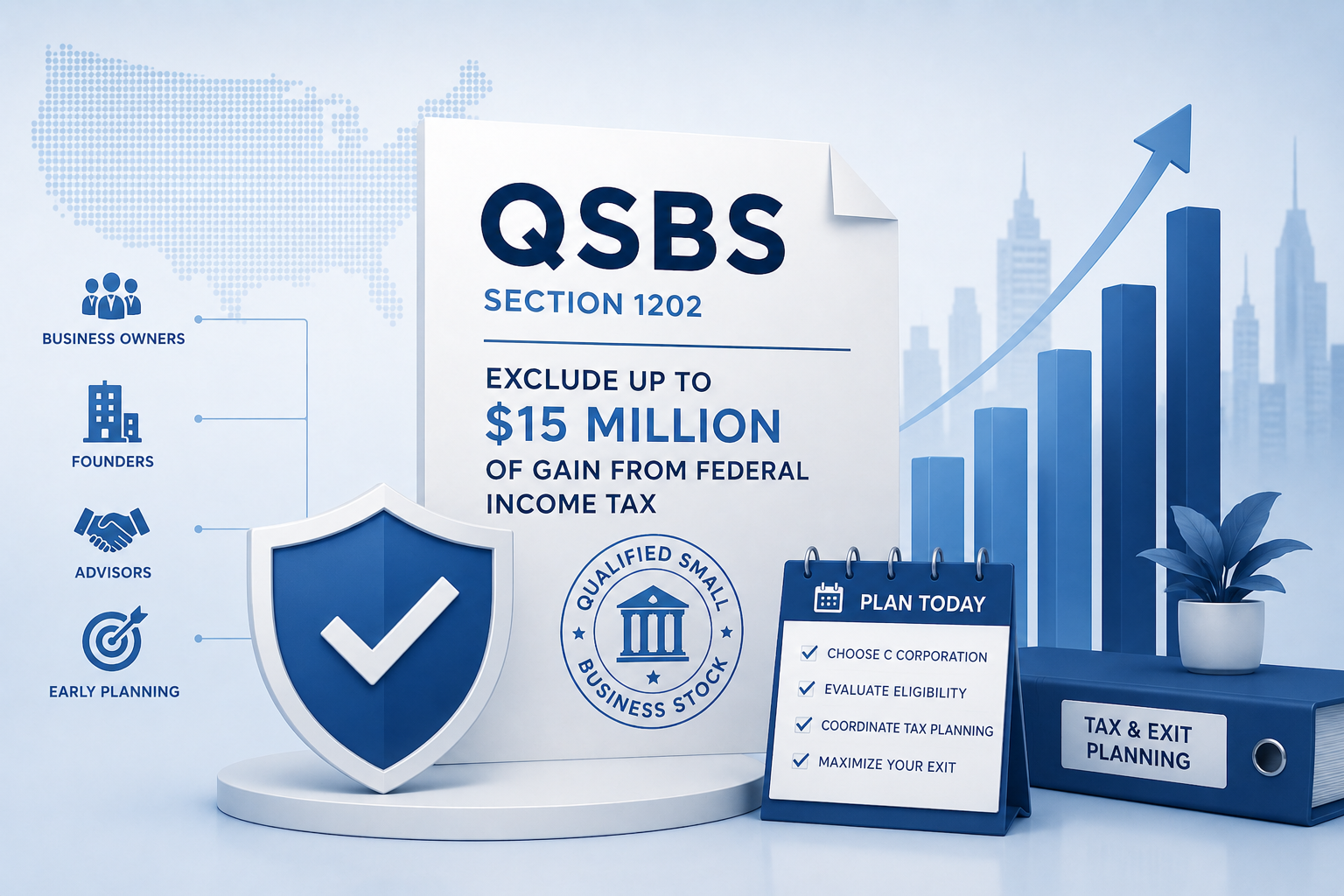
The article focuses on the expanding use of QSBS and the substantial tax savings it can provide. Section 1202 allows qualifying taxpayers to exclude up to $15 million of gain from federal income tax upon the sale of qualified small business stock. As a result, what was once viewed as a niche planning opportunity has become an increasingly important consideration for founders, investors, and closely held businesses contemplating future liquidity events.
While Bloomberg accurately captures the growing interest in QSBS, the more significant takeaway may be the increasing number of business owners who are proactively planning for QSBS eligibility and incorporating Section 1202 into their long-term growth, investment, and exit strategies – and the advisors directing their clients towards QSBS. As noted in the article, ‘bankers are pitching’ QSBS to a wide array of business owners and speakers have become a ‘hot commodity’.
“I have heard QSBS being discussed more in the last two years than I did in the previous 16 years combined,” said Anneke Niemira, a managing director at NewEdge Wealth.
QSBS Has Moved Well Beyond Silicon Valley
For years, QSBS was most commonly associated with startup founders, venture capital investors, and early employees of high-growth technology companies. That association was understandable because many venture-backed startups were already structured as C corporations, one of the fundamental requirements for QSBS treatment under Section 1202.
Today, however, advisors are increasingly discussing QSBS with manufacturers, healthcare businesses, consumer brands, logistics companies, and family-owned businesses. Much of this growing interest can be attributed to the changes enacted by Congress in 2025, including an increase in the exclusion amount from $10 million to $15 million and the introduction of benefits for shorter holding periods.
As awareness of Section 1202 continues to grow, more business owners are evaluating whether their companies may qualify and how early planning can help maximize the benefits available under the exclusion.
The article highlights Bob Dahlstrom, founder of Florida-based drone company Apellix, who did not know about QSBS when he started his company as a C corporation in 2014. Today, he is incorporating QSBS into his long-term planning and views the potential tax savings as an opportunity to preserve more of the value he created. As Dahlstrom explained, retaining more proceeds after a future sale would allow him to reinvest in future entrepreneurial ventures—a perspective that reflects one of the primary goals behind Section 1202. By encouraging business formation, investment, and long-term growth, QSBS was designed to reward the risks associated with building successful companies.
Dahlstrom’s experience illustrates why so many business owners are now evaluating QSBS eligibility years before a potential sale, rather than waiting until an exit is already on the horizon. Increasingly, owners are considering entity structure, eligibility requirements, and long-term tax planning while their businesses are still growing.
Growing Popularity Often Brings Greater Scrutiny
As QSBS has become more widely used, it has also attracted greater attention from policymakers and Treasury officials. As noted in the Bloomberg article, Treasury is taking a closer look at certain trust-based planning strategies, often referred to as “stacking,” that are designed to increase the amount of gain eligible for exclusion under Section 1202.
The government’s interest is not entirely surprising. As the value of the QSBS exclusion has increased, so has interest in planning techniques designed to maximize its benefits. Treasury’s recent comments suggest that policymakers are evaluating whether certain arrangements are consistent with the intent of Section 1202.
Importantly, neither Bloomberg’s reporting nor Treasury’s comments suggest that trust-based QSBS planning is inherently problematic. Trusts remain common tools for legitimate estate planning, succession planning, and wealth transfer objectives. Rather, the focus appears to be on situations where multiple trusts are established primarily to replicate exclusion amounts without sufficient independent economic substance or non-tax purposes.
For business owners and advisors, the broader takeaway is that increased visibility often brings increased scrutiny. As QSBS continues to grow in popularity, taxpayers should ensure that any planning strategies are supported by legitimate business, estate planning, or wealth transfer objectives and are properly documented.
Looking Ahead
Steverman reflects on how QSBS has evolved from being a technique used primarily by entrepreneurs in Silicon Valley to one that is increasingly being considered by business owners nationwide. More importantly, it highlights a shift in how business owners are thinking about QSBS. Rather than discovering Section 1202 shortly before a sale, many are evaluating eligibility much earlier and incorporating QSBS into broader business formation, growth, succession, and exit planning strategies.
For qualifying businesses, understanding the requirements of Section 1202 and planning for eligibility early can create substantial long-term value. Business owners are increasingly choosing entity structures with QSBS in mind, evaluating eligibility while their companies are still growing, coordinating tax and exit planning sooner, and viewing QSBS as part of a broader strategy to preserve wealth created through years of building a successful business.
As awareness of Section 1202 continues to expand, that trend is likely to continue. And while greater popularity may bring greater scrutiny, the growing interest in QSBS reflects its increasing importance as a planning tool for founders, investors, and business owners seeking to retain more value when they eventually exit their businesses.
This article does not constitute legal or tax advice. Please consult with your legal or tax advisor with respect to your particular circumstance.