

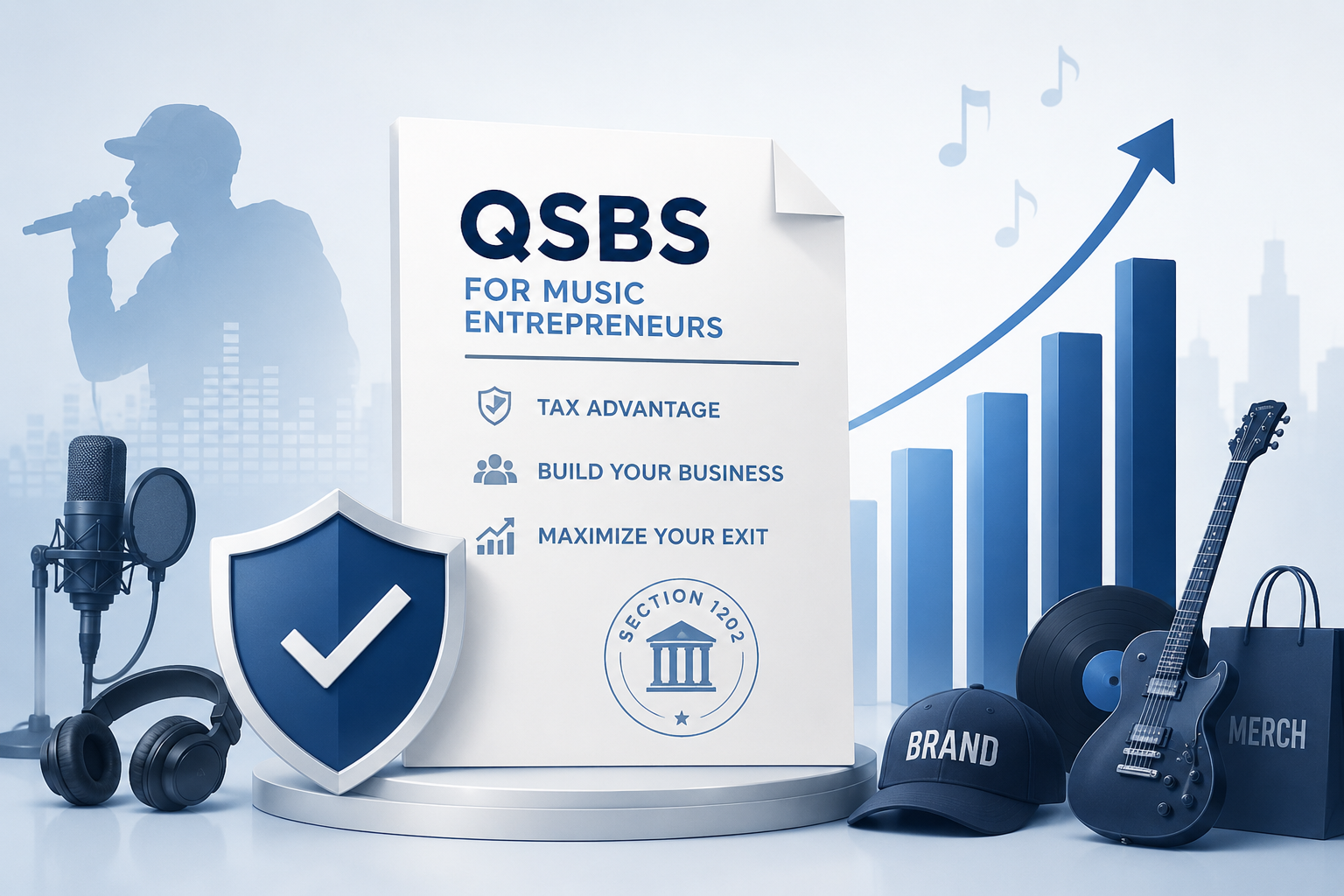
An artist can sell out tours, launch a successful merchandise brand, and build a loyal audience, yet still miss out on one of the most valuable tax incentives available to founders and early investors. That is the central message of Jared Brenner’s Forbes article, which makes a compelling case that Qualified Small Business Stock (QSBS) should no longer be viewed as a tax incentive reserved for Silicon Valley startups.
Brenner argues that QSBS, which provides an up to 100% capital gains tax exclusion, can equally apply to musicians, creators, managers, and entertainment entrepreneurs. However, careful planning needs to be considered from the earliest stages of building a business if they hope to maximize the value of a future exit through QSBS.
QSBS Moves Into the Music Industry
For years, QSBS has been associated with venture-backed technology companies. Brenner’s article highlights how the modern music business has evolved far beyond touring and record sales. Today’s artists are increasingly building scalable businesses around merchandise, apparel, beauty products, fan platforms, media ventures, and technology products. Those businesses can become acquisition targets and generate significant capital gains upon sale.
The article points to creator-led brands such as Rihanna’s Fenty Beauty and A$AP Rocky’s AWGE as examples of how entertainment personalities are transforming audiences into enterprise value. While these examples are not analyzed for QSBS eligibility specifically, they illustrate the type of creator-driven companies that may warrant early QSBS planning.
If these founders wait until a sale is on the horizon to consider QSBS planning, they may realize that they have deprived themselves of significant opportunities.
Can a Business Started by an Artist Qualify as QSBS?
An important consideration for entrepreneurs in entertainment is that Section 1202 excludes specific types of businesses from being classified as a QSBS, including both businesses involving the performance of service in “performing arts” and any business where the principal asset is the “reputation or skill of 1 or more of its employees” (See IRC Section 1202(e)(3)).
For instance, a YouTube channel built entirely around the creator’s personal content may raise different questions than a consumer products company that sells branded goods to that creator’s audience. The question of whether the company qualifies for QSBS depends on what they are actually selling and where the company’s value is primarily derived from.
This distinction helps explain why Brenner differentiates between product-focused businesses and service-oriented businesses. While businesses built around consumer products, merchandise, or intellectual property may fit more naturally within the QSBS framework, businesses whose principal asset is an individual’s reputation or performance do not. Therefore, the way in which the business is structured also becomes important.
Business Structuring Considerations
Given the potential for certain business activities to fall within excluded trades or businesses, it may be important for entertainment entrepreneurs to separate their QSBS-eligible ventures from their performing arts businesses.
Furthermore, many businesses in the entertainment industry begin as limited liability companies (LLCs) or S corporations. These structures provide flexibility and can offer favorable tax treatment during the early stages of development. QSBS, however, requires stock issued by a domestic C corporation. As a result, founders who select an entity structure without considering long-term objectives can unintentionally limit future planning opportunities.
Not Every Entertainment Business Presents the Same QSBS Considerations
Brenner’s article highlights the important distinction between different types of entertainment-related businesses because certain businesses fit into the QSBS framework better and more naturally than others.
For example, Brenner notes that artist-founded streetwear labels, creator-led beauty brands, and merchandise companies that evolve into broader consumer brands may fit more naturally within a QSBS framework because they are built around products rather than services.
In comparison, a management company may raise additional considerations because its value may be tied more closely to personal services, relationships, and professional expertise.
This distinction does not necessarily mean that service-oriented businesses are automatically disqualified. Rather, it highlights why founders should evaluate QSBS considerations early instead of assuming eligibility later.
QSBS Planning Begins Long Before a Sale
Brenner stresses how QSBS is not a tax strategy that can be implemented at the time of an exit. Rather, it is a framework that requires planning from the earliest stages of a company’s development.
Previously, shareholders had to hold qualifying stock for more than five years to receive the full federal gain exclusion. Recent legislative changes introduced phased-in benefits for certain stock issued after July 4, 2025, allowing a 50% exclusion after three years, a 75% exclusion after four years, and a 100% exclusion after five years. The enhanced benefits available for stock issued after the enactment of the OBBBA further reinforce the importance of considering QSBS planning while the business is being built rather than at the time of sale.
Also important to note is that not all stock qualifies for QSBS treatment. To qualify, stock must be acquired directly from the company at original issuance. Because of this, the way equity is issued and transferred throughout a company’s life can affect whether future shareholders qualify for QSBS treatment.
Why This Matters for Founders
The most important takeaway from Brenner’s article is that many creators are unknowingly building companies rather than simply generating income streams. Whether the business is a merchandise platform, beauty brand, media company, software venture, or consumer product line, founders who fail to consider QSBS early may leave substantial tax savings on the table.
As entertainment businesses increasingly resemble venture-backed startups, the article suggests that QSBS should become a standard part of the conversation among artists, managers, advisors, and investors. The value of a future exit may depend as much on early tax planning as it does on the success of the business itself.
Bottom Line: Brenner’s article reflects a growing trend in the QSBS world: the incentive is expanding beyond technology startups and into creator-led businesses. For music entrepreneurs building brands with long-term enterprise value, entity structure and QSBS eligibility may be as important as the next record deal or sponsorship agreement.
This article does not constitute legal or tax advice. Please consult with your legal or tax advisor with respect to your particular circumstance.