

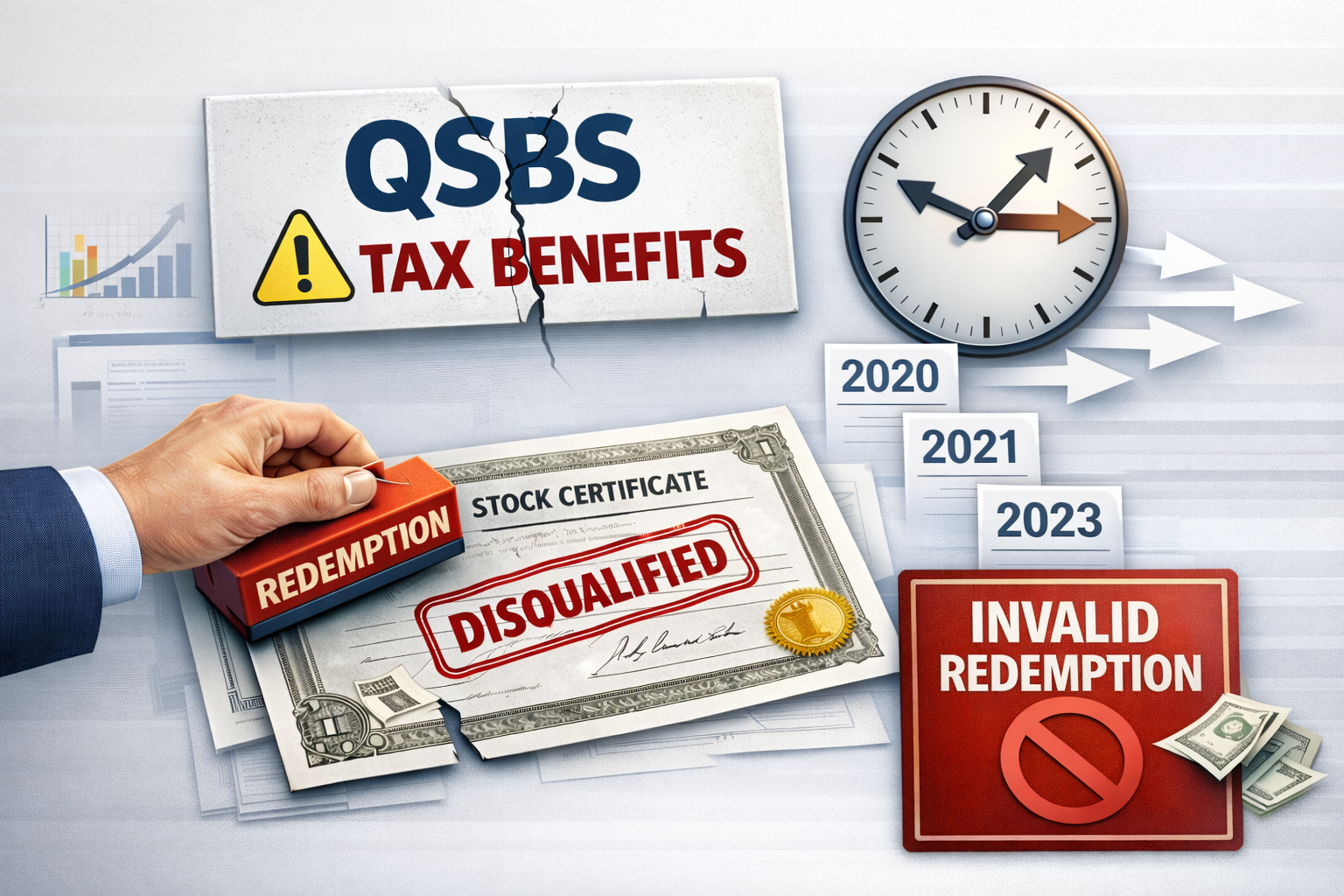
A recent article by Scott Robert Buzzard, Christopher Steele Brown, and Mark A. Melton of Holland & Knight highlights a persistent risk in the world of Qualified Small Business Stock (QSBS): stock redemption rules that can quietly undermine eligibility for one of the tax code’s most valuable benefits.
As interest in QSBS continues to grow—fueled by its potential to exclude up to $10 million or more in capital gains under Section 1202—the authors warn that many companies and investors remain exposed to technical missteps that can invalidate the exclusion entirely.
How Buybacks Can Jeopardize Tax Benefits
At the center of the issue are redemption limitations, which restrict a corporation’s ability to buy back its own stock within certain timeframes surrounding a QSBS issuance. While these rules have long been part of the statute, the authors emphasize that they remain widely misunderstood—and frequently overlooked in practice.
The risk is not merely theoretical. A company that engages in disqualifying redemptions—either in the period leading up to a stock issuance or afterward—can taint newly issued shares, even if all other QSBS requirements are satisfied. That creates a scenario in which investors may believe they hold qualifying stock, only to discover years later that the associated tax benefits are unavailable.
Part of the challenge lies in the multi-period testing framework embedded in the rules. Companies must evaluate redemption activity both before and after issuance, with certain lookback periods requiring analysis of transactions that occurred up to a year prior. This forward- and backward-looking structure makes compliance difficult, particularly for high-growth startups that regularly adjust their capitalization tables.
Valuation Uncertainty Complicates Compliance
Compounding the issue is the role of valuation. Because redemption thresholds are tied to the company’s value at specific points in time, determining whether a redemption crosses a disqualifying threshold can depend on uncertain or retrospective valuations. In fast-moving venture-backed companies, those determinations are not always straightforward—and small miscalculations can have outsized consequences.
Although the statute and related guidance provide limited exceptions, such as for certain employee-related redemptions or smaller transactions, the authors caution that these carve-outs are narrow and highly dependent on specific facts. In other words, they offer little comfort to companies that treat redemptions as routine liquidity tools without considering QSBS implications.
The Need for Ongoing QSBS Planning
The broader message is clear: QSBS planning does not end at issuance. Instead, it requires ongoing coordination between tax advisors, legal counsel, and company leadership to ensure that later corporate actions do not inadvertently erase earlier eligibility.
As policymakers continue to promote QSBS as a driver of startup investment, the article serves as a reminder that the regime’s complexity remains a barrier. For now, redemption rules stand out as one of the more subtle—but consequential—pitfalls, capable of turning a highly anticipated tax benefit into a missed opportunity.
This article does not constitute legal or tax advice. Please consult with your legal or tax advisor with respect to your particular circumstance.